 .
.B.S in Mathematics: 1987, Al.I.Cuza University of Iasi, Romania .
PhD in Mathematics: 1994, Michigan State University, USA.
Thesis advisor: Professor Thomas H. Parker: The spectral flow, the Maslov index, and decompositions of manifold
My field of expertise is global analysis with an emphasis on the geometric applications of elliptic partial differential equations arising from gauge theory, symplectic geometry and index theory for Dirac operators. In 2010 I asked my self some questions about “random”Morse functions and since then I turned into a probabilist enthusiast.
97. Kac-Rice formula and the number of critical points of random functions. These expository notes have a double purpose: (a) describe a complete proof of the Kac-Rice formula describing the expectation of Z(F)= the number of critical points of a Gaussian random function F and (b) present some ideas in the works of Gass-Stecconi and Ancona-Letendre describing conditions guaranteeing the finiteness of the p-th moment of Z(F)
96. A Graduate Course in probability, These are notes that grew out of the one-semester probability basic graduate course I taught. Now they roughly cover a year-long basic graduate course. Check the list of contents for more details.
95. Notes on Elementary probability These are notes for the undergraduate probability class I have taught at the University of Notre Dame for three years. They have been continuously update to incorporate remarks and questions from my students. The list of topics is more or less the list of topics required for the actuaries Exam-p. I believe that the best way to understand probability is from examples and by experiencing random experiments. The book discusses contains many classical examples. Additionally we have included the short R-programs used for class simulations. For this reason, the last chapter of the book offers a very basic introduction to R. We have included many exercises, of varied difficulty, inspired from undergraduate courses in US and Europe. The complete solutions are contained in Appendix B of the book.
94. The (co)normal cycle and curvature measures These are notes for a cycle of lectures I gave in the department. You can see videos of these lectures here.
93. Wiener chaos and limit theorems. I survey the concepts of Gaussian Hilbert spaces, their chaos decomposition and the accompanying Malliavin calculus. I then describe how these ingredients fit in the recent central limit theorems of Nourdin and Peccati in the Wiener chaos context.
92. Critical points of multi-dimensional random Fourier series: central limits. I complete the work in 87 and I prove a central limit theorem concerning the distribution of critical points of a multidimensional random Fourier series when the lattice of periods is rescaled by a large factor.
91. A CLT concerning the critical points of a random function on a Euclidean space We prove a central limit theorem concerning the number of critical points in large cubes of an isotropic Gaussian random function on a Euclidean space. arXiv: 1509.06200
90. On the Kac-Rice formula This is an informal introduction to the Kac-Rice formula and some of its (mostly one-dimensional) applications.
89. A stochastic Gauss-Bonnet-Chern formula, We prove that a Gaussian ensemble of smooth random sections of a real vector bundle over compact manifold canonically defines a metric on the bundle together with a connection compatible with it. Additionally, we prove a refined Gauss-Bonnet-Chern theorem stating that if the bundle and the manifold are oriented, then the Euler form of the above connection can be identified, as a current, with the expectation of the random current defined by the zero-locus of a random section in the above Gaussian ensemble.
88. The Gauss-Bonnet-Chern theorem: a probabilistic perspective, this is joint work with Nikhil Savale. We show that the Euler form determined by a metric connection on an oriented metric vector bundle can be identified as a current with the expectation of the random current defined by the zero locus of a random section of the bundle. We also explain how to recover the differential geometry of a metric vector bundle equipped with a metric connection from the statistics of a certain random section.
87. Critical points of multidimensional Fourier series: variance estimates, arXiv: 1310.5571. I show that in the white noise limit the number critical points of a multidimensional random Fourier series concentrates with high probability around its expectation.
86. Introduction to Real Analysis These are notes for a yearlong freshman honors course on one-variable real analysis.
85. Notes on linear algebra. These are notes for the second half of the yearlong honors course on linear algebra.
84. The Crofton formula These are notes for a graduate class. I give a proof of the Crofton formula for plane curves.
83. Fluctuations of the number of critical points of random trigonometric polynomials I show that the number of critical points of a random trigonometric polynomial of large degree concentrates with high probability around its expectation.
82. Random Morse functions and spectral geometry This is a continuation of 79. To each even, nonnegative Schwartz function $w(t)$ on the real axis I associate a random function on a compact Riemann manifold $(M,g)$ of dimension $m$. I investigate the expected distribution of critical values of such a random function and its behavior as we rescale $w(t)$ to $w(\varepsilon t)$ and then let $\varepsilon\to 0$. I prove a central limit theorem describing what happens to the expected distribution of critical values when the dimension of the manifold is very large. Finally, I explain how to use the $\varepsilon\to 0$ behavior of the random function to recover the Riemannian geometry of $(M,g)$.
81. The wave group and the spectral geometry of compact manifolds I am trying to learn Hormander's estimates of the spectral function of the Laplacian on a compact Riemannian manifold. This is more of a struggle than I had anticipated and these time dependent notes are the result of this struggle. They're supposed to be as self-contained as possible, but familiarity with basics of distribution theory is assumed. In the second part, familiarity with basics of pseudo-differential operators is recommended. The first two chapters of my lecture notes on these two topics could serve as a source for this assumed backround.)
80. Combinatorial Morse flows are hard to find I investigate the probability of detecting combinatorial Morse flows on a simplicial complex via a random search. It is really small, in a quantifiable way.
79. Complexity of random smooth functions on compact manifolds I relate the distribution of eigenvalues of a random symmetric matrix in the Gaussian Orthogonal Ensemble to the distribution of critical values of a random linear combination of eigenfunctions of the Laplacian on a compact Riemann manifold. I then prove a central limit theorem describing what happens when the dimension of the manifold is very large.
78. Jets of the distance function If you ever wanted to know how to compute the jets along the diagonal of the distance function on a Riemann manifold, then this note might be what you are looking for. I asked many Riemannian geometers how to compute these jets but none could give a reference. The usage of the Hamilton-Jacobi equations makes these computations bearable.
77. The generalized Mayer-Vietoris principle and spectral sequences. These are notes for a the Fall 2011 Topics class. I use Bott-Tu as guide but I at various places I use different approaches. You may also want to consult these notes on the cohomology of sheaves.
76. Intersection theory I cover in greater details the intersection theoretic results in Bottt-Tu. These are notes for a Fall 2011 topic class.
75. Pixelations of planar semialgebraic sets (this is joint work with Brandon Rowekamp) We describe an algorithm that associates to each positive real number $r$ and any finite collection $C_r$ of planar pixels of size $r$ a planar piecewise linear set $S_r$ with the following additional property: if $C_r$ is the collection of pixels of size $r$ that touch a given compact semialgebraic set $S$, then the output $S_r$ of the algorithm converges to the set $S$ in a rather strong way. The above strong converges guarantees that in the limit we can recover the homotopy type of $S$ and geometric invariants such as area, perimeter and curvature measures. At its core, this algorithm is a a discrete version of stratified Morse theory. Here is a beamer presentation of the juiciest parts.
74. Flat currents and their slices. These are notes for a talk at the ''Blue Collar Seminar on Geometric Integration Theory''.
73. The blow up along the diagonal of the spectral function of the Laplacian I describe a surprising universal behavior of the spectral function of the Laplacian of a compact Riemann manifold.
72. The coarea formula These are notes for a talk at the ''Blue Collar Seminar on Geometric Integration Theory''.
71. Critical sets of random smooth functions on compact manifolds I estimate the expected number of critical points of a random linear combination of eigenfunctions of the Laplacian on certain compact Riemann manifolds. (Here is a nice animation with random functions on spheres.) Here is a beamer presentation of the most important results.
70.
Statistics
of linear families of smooth functions on knots.
Given a finite dimensional vector space of smooth functions on a
knot, I compute the expected number of critical points of a random
function in this space. As a consequence, I show that the expected
number of critical points of the restriction to the unit circle in
the plane of a random homogeneous polynomial of given degree k is
equal to
.
57. On the total curvature of semialgebraic graphs_ arXiv: 0806.3683 We define the total curvature of a semialgebraic graph $\Gamma\subset \bR^3$ as an integral $K(\Gamma)=\int_\Gamma d\mu$, where $\mu$ is a certain Borel measure completely determined by the local extrinsic geometry of $\Gamma$. We prove that it satisfies the Chern-Lashof inequality $K(\Gamma)\geq b(\Gamma)$, where $b(\Gamma)=b_0(\Gamma)+b_1(\Gamma)$, and we completely characterize those graphs for which we have equality. We also prove the following unknottedness result: if $\Gamma\subset \bR^3$ is homeomorphic to the suspension of an $n$-point set, and satisfies the inequality $K(\Gamma) <2+b(\Gamma)$, then $\Gamma$ is unknotted. Moreover, we describe a simple planar graph $G$such that for any $\varepsilon>0$ there exists a knotted semialgebraic embedding $\Gamma$ of $G$ in $\bR^3$ satisfying $K(\Gamma)<\varepsilon +b(\Gamma)$.
56. On a Bruhat-like poset_ arXiv: 0711.0735 We investigate the poset of strata of the stratification introduced in the paper 55.
55. Schubert calculus on the Grassmannian of hermitian lagrangian subspaces_ arXiv: 0708.2669, Adv. Math. 2010, doi:10.1016/j.aim.2010.02.003 We describe a Schubert like stratification on the Grassmannian of hermitian lagrangian spaces in $\mathbb{C}^n\oplus \mathbb{C}^n$ which is natural compactification of the space of hermitian $n\times n$ matrices. The closures of the strata define integral cycles, and we investigate their intersection theoretic properties. The methods employed are Morse theoretic.
54. Tame flows math.GT/0702424, (Memoirs A.M.S.) The tame flows are ``nice'' flows on ``nice'' spaces. The nice (tame) sets are the pfaffian sets introduced by Khovanski, and a flow $\Phi: \mathbb{R}\times X\rightarrow X$ on pfaffian set $X$ is tame if the graph of $\Phi$ is a pfaffian subset of $\mathbb{R}\times X\times X$. Any compact tame set admits plenty tame flows. We prove that the flow determined by the gradient of a generic real analytic function with respect to a generic real analytic metric is tame. The typical tame gradient flow satisfies the Morse-Smale condition, and we prove that in the tame context, under certain spectral constraints, the Morse-Smale condition implies the fact that the stratification by unstable manifolds is Verdier and Whitney regular. We explain how to compute the Conley indices of isolated stationary points of tame flows in terms of their unstable varieties, and then give a complete classification of gradient like tame flows with finitely many stationary points. We use this technology to produce a Morse theory on posets generalizing R. Forman's discrete Morse theory. Finally, we use the Harvey-Lawson finite volume flow technique to produce a homotopy between the DeRham complex of a smooth manifold and the simplicial chain complex associated to a triangulation. Here is a beamer presentation of the most important results.
53. Curvature measures I like very much how these notes turned out. This is an old subject,_ and in these notes I dress it in some new clothes.
52. Metoda functiilor generatoare (“Gazeta Matematica’’, 2007’). Try this if you can read Romanian.
51. Morse functions statistics, math.GT/0604437, _Functional Analysis and Other Applications, 1(2006), 97-103. I answer a question of V.I. Arnold concerning the growth of the number of Morse function on the 2-sphere. Read more about this problem. Also, you can watch Arnold talking about this.
50. Counting Morse functions on the 2-sphere, math.GT/0512496. Compositio Math., 144(2008), 1081-1106. This paper is inspired by earlier work of V.I. Arnold. We compute the number of excellent Morse functions on the two sphere. Here are beamer slides on this topic.
49. The anatomy of a singularity, These are notes for a Felix Klein Seminar.
48. Notes on Morse theory,These are notes for the Fall 2005,“Topics in topology” course.
47. On a multidimensional checkers game, This is a generalization of a problem from the Budapest semester in math that I learned from A. Stipsicz. I suspect somebody else has thought of this generalization before, but in any case, here it is.
46. The Euler characteristic, Some nice consequences of really elementary tricks.
45. Characteristic currents of singular connections
43. Notes on the Atiyah-Singer index theorem, These are notes for the Math 658 , Spring 2004 course, “Topics in topology”.
42. Microlocal studies of shapes I begin by describing two classical instances where the conormal cycle makes its appearance and then I describe its construction in the special case of simplicial complexes.
41. Derangements and asymptotics of Laplace transforms of polynomials __math.CO/0401281 & New York Journal of Mathematics, v.10(2004), 117-131. This is an amusing elementar problem with surprising ramifications.
40. “Motivic” Integral Geometry_ Here I am trying to understand a beautiful little paper of Pierre Schapira. For an approach to this problem using tame geometry check here.
39. The Poincare-Verdier duality
38. Chern classes of singular algebraic varieties, Try this link from time to time.
37. On the curvature of singular complex hypersurfaces, Talk at the Felix Klein Geometry Seminar, Fall 2003, Notre Dame.
36. The many faces of the Gauss-Bonnet theorem, This little expository paper is an extended version of my talk at the Graduate Student Seminar, Fall 2003.
35. Three-dimensional Seiberg-Witten theory, Notes for a mini-course in Grenoble.
34. Notes on the topology of complex singularities , (PDF, Revised 07/11/2001) This is an ongoing process. I have included lots of NEW examples.
32. Homeomorphisms vs. Diffeomorphisms This little expository paper is an extended version of my talk at the 2003 ``First year graduate student seminar''.
31. Residues and Hodge Theory This expository paper is an extended version of my talks at Karen Chandler's ``Absolutely fabulous algebraic geometry seminar''.
30. Solutions to some problems in Hatcher's Algebraic Topology book.
29. Seiberg-Witten invariants and surface singularities III. Splicings and cyclic covers, math.AG/02071018 (joint with Andras Nemethi) We prove the conjecture formulated in 25 for suspension sigularities, i.e. isolated surface singularities of the form z^n+ f(x,y)=0, where, f(x,y)=0 is an irreducible plane curve.
28. Seiberg-Witten invariants and surface singularities. This is a summary of 25 and 26.
27. Of shapes, differentials and integrals. This little expository paper is an extended version of my talk at the 2002 ``First year graduate student seminar''.
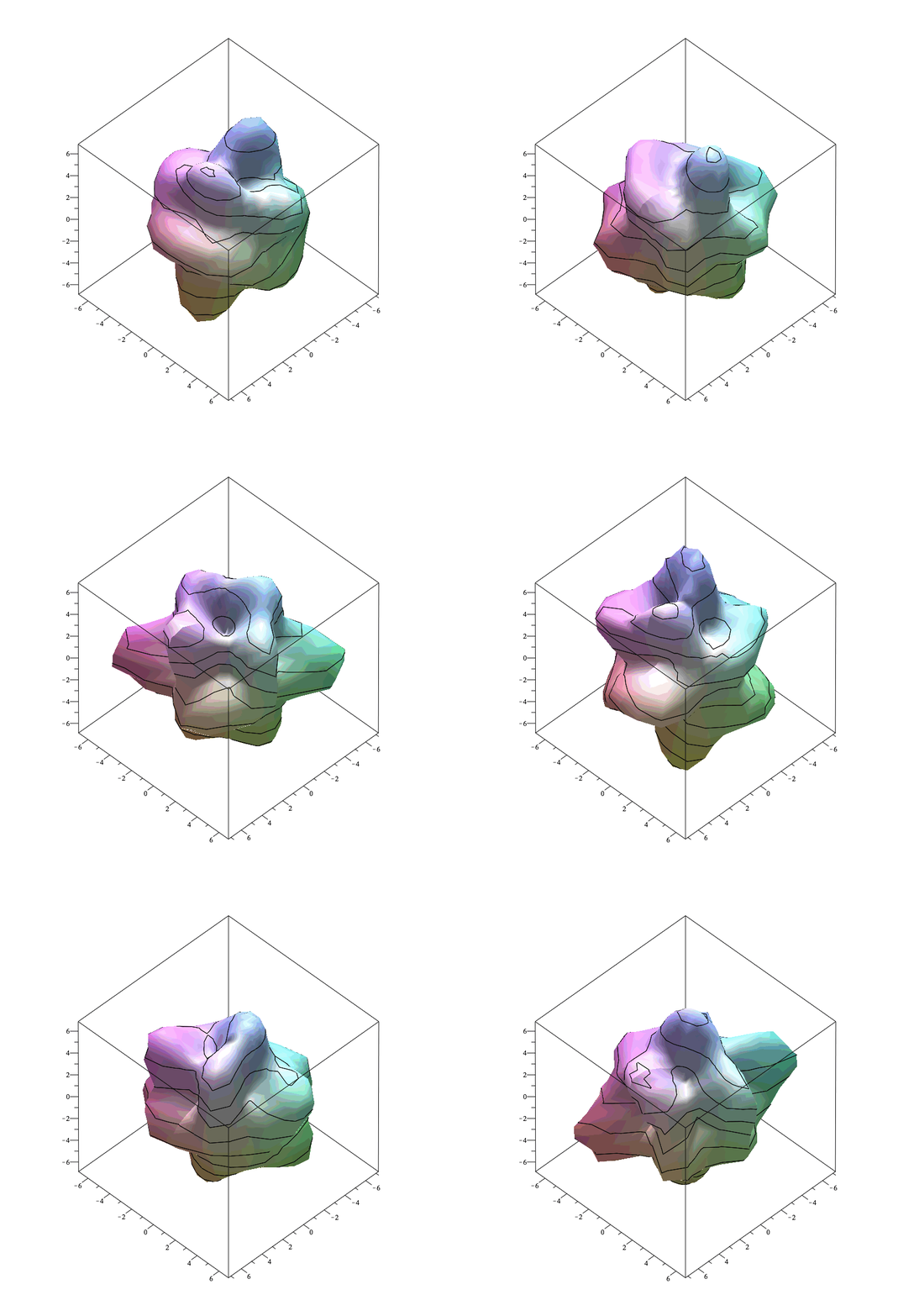
26. Seiberg-Witten invariants and surface singularities II. Singularities with good $C^*$-action, math.AG/0201120 (joint with Andras Nemethi) We prove that the geometric genus of an isolated quasihomogeneous surface singularity whose link is a rational homology sphere is completely detremined by the Seiberg-Witten invariant and the Gompf invariant of the canonical spin^c structure on the link of this singularity. When the sigularity is smoothable this implies that the Seiberg-Witten invariant of the canonical spin^c structure is -1/8 the signature of the Milnor fiber. Note although these singularities are analytically rigid some are neither Gorenstein, nor rational. Which is then the best rigidity condition?
25. Seiberg-Witten invariants and surface singularities I, math.AG/0111298, Geometry and Topology, 6(2002), 269-328, (joint with Andras Nemethi) We formulate a conjecture relating analytic invariants of isolated surface singularities to topological invariants of the links of those singularities, which are assumed to be rational homology 3-spheres. More precisely we show that the link of such a singularity is equipped with a canonical spin^c structure. We conjectured that if the singularity is Gorenstein or rational then its geometric genus is determined in a simple explicit fashion by the Seiberg-Witten invariant and the Gompf invariant of this canonical spin^c structure. To support this conjecture we establish its validity on many classes of singularities: Brieskorn, cyclic quotient singularities, A-D-E singularities, polygonal singularities etc. This considerably generalizes earlier results of Fintushel-Stern, Neuwmann-Wahl.
24. Seiberg-Witten invariants of 3-manifolds. Part 1 This unfinished manuscript describes in great detail the construction of SW theory of 3-manifolds, closed or with boundary. It has considerable overlap with published work of Yuhan Lim and Marcolli-Wang (which is why I never finished it and I will never publish it). However, I adopt a sufficiently new point of view to make it useful for references. In particular, I am careful in figuring out the various signs. There are a couple of other folklore results for which I could not find references.
23. Seiberg-Witten invariants of rational homology spheres math.GT/0103020, Comm. Contem. Math. I prove that for rational homology 3-spheres SW invariant <==> Casson-Walker invariant + Reidemeister torsion.
22. Geometric connections and geometric Dirac operators on contact manifolds, math.DG/0101155, Diff. Geom and its Appl. I construct several natural connections and Dirac type operators on a general metric contact manifold which are more sensitive to the geometric background. In the special case of CR manifolds these connections are also compatible with the CR structure and include among them the Webster connection. We also describe several Weitzenbock type formulae. Our method is based on work of P. Gauduchon applied to two almost complex manifolds naturally associated to a given metric contact manifold.
21. On the Reidemeister torsion of rational homology spheres, (PDF) math.GT/0006181, Int. J. of Math and Math Sci. 25(2001), 11-17. I prove that the mod Z reduction of the torsion of a rational homology 3-sphere is completely determined by three data: a certain canonical spin^c structure, the linking form and a Q/Z-valued constant c. This constant is a new topological invariant of the rational homology sphere. Experimentations with lens spaces suggest this constant may be as powerful an invariant as the torsion itself.
20. Notes on Seiberg-Witten theory, (Monograph, xii+ 482pp, Graduate Series in Math., vol. 28, Amer. Math. Soc., 2000) What can I say about my baby!?! It has to be beautiful. It took me two years to write this book, and finally here it is. There's a lot of interesting stuff in it, such as a new and almost complete presentation of the gluing theory which you won't find elsewhere. Click on the title to learn some more about it.
19. The Reidemeister Torsion of 3-Manifolds, Walter de Guyter, January 2003. I survey, mainly through very concrete examples, various interpretations of this topological invariant. I think you will find many nice old things and new ones.
18. On the space of Fredholm selfadjoint operators, (PDF),_ An. Sti. Univ. Iasi, 53 (2007), p.209-227. This is a paper is dedicated to the memory of my good friend Gheorghe Ionesei, the ultimate math poet. You can find here his cute proof of the Abel-Jacobi theorem. In this paper I compare various natural topologies on the space of (possibly unbounded) Fredholm selfadjoint operators and describe which one is relevant for K-theory. In the process, I fix a gap in 7 indicated to me by Bernhelm Booss-Bavnbeck and K. Furutani.
17. Eta invariants, spectral flows and finite energy Seiberg-Witten monopoles, ( PDF file, 21 pages), "Geometric Aspects of Partial Differential Equations" -Proceedings of a Minisymposium on Spectral Invariants, Heat Equation Approach Held September 1998 in Roskilde Denmark with support from Danish Research Council; B. Boss- Bavnbek, K. Wojciechowski Editors. Contemporary Mathematics, vol.242, Amer. Math. Soc, Providence R.I., 1999.This survey summarizes the results in 10, 11 and 13. Read this first if you are interested in those papers.
16. Seiberg-Witten invariants of lens spaces. math.DG/9901071, Canad. J. Math., 53(2001), 780-808. It contains an algorithm based on the ideas in 13, for computing Seiberg-Witten invariants of lens spaces. We apply this algorithm to two problems: (i) to compute the Froyshov invariants of many families of lens spaces; (ii) to show that the knowledge of the Seiberg-Witen invariants of a lens space is topologically equivalent to the knowledge of its Casson-Walker invariant + the Milnor-Turaev torsion. Problem (i) has interesting applications concerning the negative definite manifolds bounding a given lens space. (The published version contains less information that the version on the network.)
15. On the Cappell-Lee-Miller gluing theorem, math.DG/9803154, 26 pages, Pacific J.of Math, 206(2002), 159-185. I formulate a more conceptual interpretation of the Cappell-Lee-Miller theorem using the new laguage of asymptotic maps and asymptotic exactness. Additionally, I present an asymptotic description of the Mayer-Vietoris sequence naturally associated to the Cech cohomology of the sheaf of local solutions of a Dirac type operator. I discuss applications to eigenvalue estimates and approximation of obstruction bundles arising in gauge theory.
14. Lattice points inside rational simplices and the Casson invariant of Brieskorn spheres, math.DG/9801030, Geometriae Dedicata, 88(2001), 37-53. I prove a special case of a conjecture of Kronheimer and Mrowka relating the Euler characteristic of the Seiberg-Witten-Floer homology of some Brieskorn spheres to their Casson invariant. The proof is arithmetic in nature and is based on a formula expressing certain lattice-point-counts via Dedekind-Rademacher sums.
13. Finite energy Seiberg-Witten moduli spaces on 4-manifolds bounding Seifert fibrations, dg-ga/9711006, Comm. Anal and Geom., 8(2000), 1027-1096. I extend the results of 11 to the case of Seifert manifolds. The main moment in the proof is the computation of the eta invariants of the Dirac operators arising in the solutions of the Seiberg-Witten equations on Seifert manifolds. We express these invariants in terms of the so called Dedekind-Rademacher sums. This paper extends previous work of Mrowka-Ozsvath-Yu where they studied the same problem when the 4-manifold is a cylinder. As an application of these computation we obtain (often optimal) upper bounds for the Froyshov invariant of Brieskorn homology spheres. These lead to interesting information about the intersection forms of negative definite 4-manifolds bounding such homology spheres.
12. On a theorem of Henri Cartan concerning the equivariant cohomology , math.DG/0005068, An. Sti. Univ. Iasi, 45(1999), 1-17. I give a new proof of a theorem of H. Cartan concerning the equivariant cohomology of the infinitesimally free smooth actions of compact Lie groups. The approach is based on a BRST isomorphism of J. Kalkman and the unusual strategy of connecting two genuine geometric objects (connections in a principal bundle) via a path of virtual (formal) ones. The resulting isomorphism is described at the chain level. My interest in equivariant cohomology is due to its presence in gluing formulae for gauge theoretic invariants.
11. Eta invariants of Dirac operators on circle bundles over Riemann surfaces and virtual dimensions of finite energy Seiberg-Witten moduli spaces, math.DG/9805046, Israel J. Math., 114(1999), 61-123. This is a continuation of the paper 10. I am primarily interested in the virtual dimensions of finite energy Seiberg-Witten moduli spaces on 4-manifolds bounding a disjoint union of circle bundles over Riemann surfaces. In the special case when the manifold is a cylinder based on such a circle bundle this dimension was determined by Mrowka-Ozsvath-Yu by algebraic-geometric techniques. I use a differential-geometric approach based on the Atiyah-Patodi-Singer theorem. This requires firstly the determination of the eta invariants of some Dirac operators. I present two entirely distinct methods to achieve this. The first method relies on the Bismut-Cheeger-Dai adiabatic results while the second method is more elementary and allows me to determine the entire eta function. An important part of the virtual dimension formula is a certain spectral flow. This is determined at the end of a very delicate perturbation analysis.
10. Adiabatic limits of the Seiberg-Witten equations on Seifert manifolds, Comm. Anal. and Geom., 6(1998), 331-392. I describe explicitly the behavior of the solutions of the Seiberg-Witten equations on a Seifert 3-manifold as its natural Thurston geometry degenerates along the fibers. The adiabatic limits are abelian vortices on the base of the Seifert fibration and can be equivalently described as a zeroth order perturbation of the Seiberg-Witten equations. This perturbed equation was independently studied by Mrowka-Ozsvath-Yu.
9. Lectures On The Geometry Of Manifolds, monograph, 475 + pages, World Scientific Publishing Co., 1996, 2nd Edition 2007. This is an expanded version of the graduate course on Differential Geometry and Global Analysis I gave at the University of Michigan in the Winter of 1996. It is addressed primarily to the graduate students specializing in global analysis and gauge theory.
8. On the cobordism invariance of the index of Dirac operators, Proceedings A.M.S., 125(1997), 2797-2801. I show that any cobordism between two Dirac operators $D_0$, $D_1$ defines a natural tunneling isomorphism $\ker D_0 \oplus \ker D_1^* \rightarrow \ker D_1 \oplus \ker D_0^*$. In particular, this provides a very intuitive explanation for the equality $ ind D_0= ind D_1$. This tunneling map has potential applications in the recent $spin^c$ quantization theory of V. Guillemin and his school.
7. Generalized symplectic geometries and the index of families of elliptic problems, Memoirs A.M.S., vol. 128, Number 609, 1997. This is a far reaching generalization of the first half of my thesis. I prove a ``surgery'' formula for the index of an arbitrary family of Dirac operators. This arbitrariness encompasses two aspects. The family is parameterized by an arbitrary compact CW-complex and moreover we also discuss higher K-theoretic indices. I proposed a method which deals simultaneously with both difficulties. I first cast the problem in a symplectic framework and then I deal with it using a generalization of the symplectic reduction technique. Again a central player is a higher dimensional version of the Maslov index which is given a dual interpretation, K-theoretic and symplectic. A nice byproduct of this work is an ``adiabatic proof'' of a very general result concerning the cobordism invariance of the index of families.
6. Morse theory on grassmannians, An. Sti. Univ. Iasi, 40 (1994), p.25-46. The adiabatic study in 5 relies on a finite dimensional dynamical system on a lagrangian grassmannian. In this paper we show that this flow has some very nice properties: it is the gradient flow of a natural, homologically perfect, self-indexing Morse function. This is related to work of R. Bott in the 50s. Moreover, the flow is explicitly integrable. This work is now superseded by 55.
5. The spectral flow, the Maslov index and decompositions of manifolds, Duke Univ.J , 80(1995), p.485-534. This is essentially my PhD dissertation. I prove a gluing formula for the spectral flow of a path of selfadjoint Dirac operators (on a manifold cut in two parts by a hypersurface) in terms of an infinite dimensional Maslov index. To get a better understanding of this infinite-dimensional contribution I ``stretch'' indefinitely the neck of the separating hypersurface and then explicitly describe the behavior of this Maslov index in the adiabatic limit.
4. Rigidity of generalized laplacians and some geometric applications, Aequationes Mathematicae, 48(1994), p.143-162. This is my first paper as a graduate student. One consequence of this work is that a Riemann metric is determined (up to a homothety) by its associated sheaf of (locally defined) harmonic functions.
3. A weighted semilinear elliptic equation involving critical Sobolev exponents, Differential and Integral Equations, 4(1991), p.653-671. I study the critical situations for the equations considered in the previous paper. This work extends previous results of H. Brezis and L. Nirenberg.
2. Existence and regularity for a singular semilinear Sturm-Liouville problem, Differential and Integral Equations, 3(1990), p.305-322. I study the radially symmetric solutions of a semilinear elliptic problem on a ball equipped with a radially symmetric but possibly singular metric. The singular metric defines a new critical Sobolev exponent (with respect to suitable weighted Sobolev spaces). This paper is concerned with with existence and regularity in the (singular) sub-critical case.
1. Optimal control for a nonlinear diffusion equation, Richerche di matematice, vol. 37 (1988), p.3-27. This is essentially my senior thesis. I solve a problem posed by J. I. Diaz and A. Friedman concerning a reaction-diffusion process at equilibrium controlled by a catalyst. The goal is to determine the optimal distribution of catalyst which produces the maximum amount of output. One also has to take into account some cost considerations. After deriving first-order optimality conditions in the form of nonlinear variational inequalities I then solve them explicitly using the technique of symmetric rearrangements.
__________________________________________________________________________________________________________________________________________________________
10. Concentration of measures This is the senior thesis of Misha Sweeney. He surveys some classical and modern concentration of measure results and presents a few applications
9. Information theory This is the senior thesis of Patrick LeBlanc. He studies the entropy of probability measures on finite sets (alphabets) and its relationtip to coding various ergodic communications.
8. Crofton formulae, This is the senior thesis of Paul Sweeney. He proves The Croftonformula for curves and hypersurfaces in an Euclidean space.
7. Markov chains:A Random Walk Through Particles, Cryptography, Websites and Card Shuffling, This is the senior thesis of Mike McCafferty. He goes through the basic facts about Markov chains, proves ergodicity and various of the limit theorems and then looks at various examples of Markov chains produced via the Metropolis-Hastings algorithm. He has also implement in R a decryption procedure discussed by Perci Diaconis in a Bulletin AMS survey.
6. A study of planar pixelation, This is the PhD dissertation of Brandon Rowekamp. He describes how to recognize the essential geometric features (area, perimeter, curvature, Betti numbers) of a planar set from its pixellations.
5. Regularization of divergent series and Tauberian theorems, This is the senior thesis of Jack Enyart. Nice introduction to the subject.
4. Localization formulae in odd K-theory,This is the PhD dissertation of Daniel Cibotaru. I like very much how it turned out, and I am sure it will find applications.
3. Two proofs of the DeRham theorem,This is the senior thesis of my student Andrew Fanoe. He goes through two different proofs of the classical DeRham theorem, the geometric one by H. Whitney, and the more algebraic one due to A. Weil. I think he improved on Weil’s presentation by using the concept of (semi)simplicial sets.
2._ Asymptotics of oscillatory integrals This is the senior thesis of my student R. Zach Lamberty. He describes on a concrete two dimensional example Varcheko’s technique of investigating the asymptotics of oscillatory integrals via toric resolutions of the phase. Check it out ! I like how it came out.
1. Geometric Valuations Very nice notes by the REU students Cordelia Csar, Ryan Johnson_ and Zach Lamberty