|
| Current Projects |
|
| Current Projects |
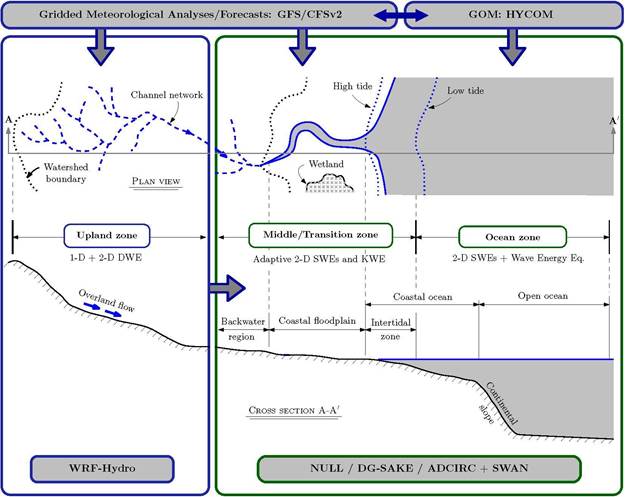
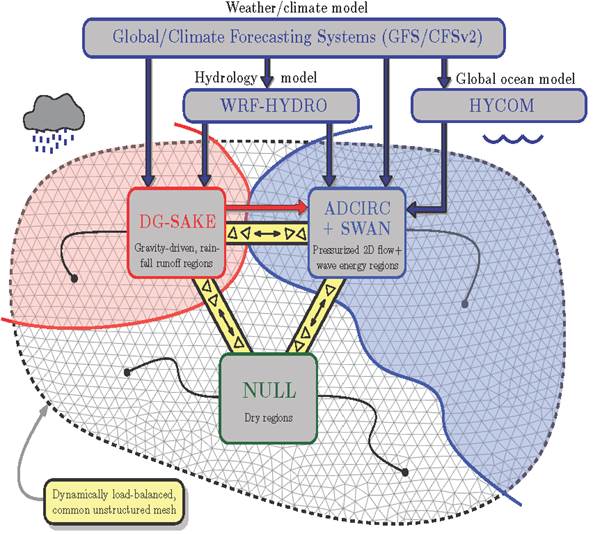
A Dynamic Unified Framework for Hurricane Storm Surge Analysis and Prediction Spanning across the Coastal Floodplain and Ocean Project Announcement: In the wake of wildfires and earthquakes, hurricanes and floods, NSF awards $19 million in natural hazards research grants Project Team: Notre Dame: Joannes Westerink (PI); University of Texas at Austin: Clint Dawson (co-PI); Ohio State University: Ethan Kubatko (co-PI); University of Illinois at Urbana-Champaign: Laxmikant Kale Project Summary: Storm-driven coastal flooding is influenced by many physical processes including riverine flows, regional rainfall, wind, atmospheric pressure, wave-induced set up, wave runup, tides, and fluctuating baseline ocean water levels. Operational storm surge models such as NOAA's Extratropical Surge and Tide Operational Forecast System (ESTOFS) incorporate a variety of these processes including riverine discharges, atmospheric winds and pressure, waves, and tides. However, coastal surge models do not typically incorporate the impact of rainfall across the coastal floodplain nor fluctuations in background water levels due to the oceanic density structure. Nonetheless, the floodplain hydrology and ocean baseline water levels provide vital controls in riverine and estuarine environments (e.g., the dramatic effect seen in the Houston metropolitan region during Hurricane Harvey in 2017 and in North Carolina during Hurricane Florence in 2018). Recent events have shown that a unified approach that incorporates all of the relevant physical processes is critical for accurate predictive simulations of coastal flooding due to extreme events. This project will tackle this challenge by melding hydrology, hydraulics, and waves into a dynamic unified computational framework that uses unstructured meshes spanning from the deep ocean to upland areas and across the coastal floodplain. More accurate coastal flood forecast and analysis models will better inform forecasters in the National Weather Service and state and local disaster managers to issue warnings for evacuation and emergency planning. In addition, insurance companies and planners will be better able to assess flood risk in coastal zones. Finally, improved flood models will lead to better guidance on development and construction practices and will help make cities more resilient and will reduce risk for coastal populations and infrastructure. The proposed unified framework will improve the predicted water level gradient and flows throughout the coastal floodplain by integrally considering the rainfall-driven hydrology within the coastal floodplain and improving the background open ocean water level. Well-developed but coarse global ocean models will be heterogeneously coupled to a high-resolution 2D shallow water equation model in order to account for large-scale baroclinic ocean processes that impact coastal water levels. Specifically temperature and salinity fields and vertical velocity profiles will be extracted from a global three dimensional HYCOM model and downscaled and used to drive baroclinic pressure gradient terms and internal tide generation/dissipation terms in a high resolution two dimensional implementation of ADCIRC. This will account for the impact of the ocean’s baroclinicity and current systems on coastal and inland water levels. Across the coastal floodplain, rainfall runoff will be gravity driven and is described well by the kinematic wave equation. On the other hand, as storm surge propagates overland, the flow pressurizes and the flow is described by the shallow water equations. We will develop strategies to dynamically apply the correct governing equations/physics depending on the prevailing hydraulics. Interface strategies and conditions between heterogeneous physics will be developed that allow the interfaces to move in time and space for the range of physics, from dry to surface runoff to pressurized flow. Applying the right physics and associated mathematical models as the storms evolve will result in more robust, accurate and efficient models. Thus our approach will dynamically account for the hydrologic-hydrodynamic interaction of water across the floodplain. Dynamic load balancing will account for widely varying CPU costs for each set of physics and the dynamic migration of the physics will be implemented within a heterogeneous parallel computing environment.
_____________________________________________________________________________________ |
Advancing ADCIRC U.S. Atlantic and Gulf Coast Grids and Capabilities to Facilitate Coupling to the National Water Model in ESTOFS Operational Forecasting Project Sponsor: National Oceanic and Atmospheric Administration (NOAA) FY 2018 Joint Technology Transfer Initiative Project Team: Notre Dame: Joannes Westerink (PI), William Pringle (Research faculty), Maria Teresa Contreras-Vargas (Ph.D. student); NOAA’s National Ocean Service - Coast Survey and Development Laboratory (in-kind): Saeed Moghimi (co-PI), Sergey Vinogradov(co-PI); NOAA’s National Center for Environmental Prediction (in-kind): Andre van der Westhuysen (co-PI) Project Goal: Implement physics based refinements, computational efficiency strategies, and improved and automated meshing strategies within and in support of the ADCIRC code in order to produce the next generation Extratropical Surge and Tide Operational Forecast System (ESTOFS) for the U.S. Atlantic, Gulf of Mexico and Caribbean coasts and floodplains. ADCIRC total water levels will incorporate hydrologic rainfall/runoff and the impact of the ocean’s temperature and salinity fields and current systems. We are implementing a coupling to the National Water Model (NWM) WRF-Hydro code at both upstream and lateral boundaries of ADCIRC’s wet/dry interface. Direct rainfall volume over ADCIRC’s inundated coastal floodplain regions will also be included using GFS rainfall data. Baroclinically driven physics in ADCIRC will be incorporated using RTOFS/HYCOM density fields to simulate the inter- and intra-annual fluctuations in the coastal background water levels, the effect of major ocean current systems such as the Gulf Stream and to include the dissipative effects of internal tides generated over steep topography with significant density gradients. Our updated model will also be tightly two way coupled to WAVEWATCH III to force the radiation stress terms in ADCIRC and enhance coastal setup. All model couplings will interact through the ESMF/NUOPC/NEMS infrastructure. We are also implementing an updated version of ADCIRC that will bypass dry floodplain elements through loop re-organization and clipping and will rebalance element subdomain assignments using Zoltan in order to maintain equal subdomain/core compute loads as elements wet and dry throughout the computational domain. This will eliminate most of the costs of handling dry elements and thus allow for more efficient computations and/or higher resolution floodplain meshes. We will also develop improved capabilities to automatically generate more accurate, less expensive, and more robust meshes through the objective/parameter based OceanMesh2D software.
|
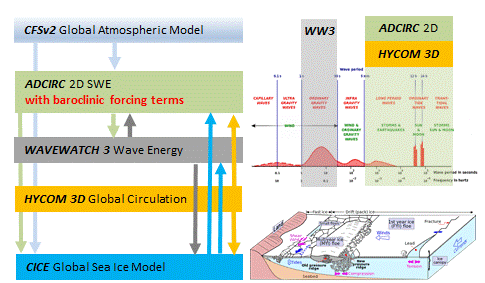
Building Coupled Storm Surge and Wave Operational Forecasting Capacity for Western Alaska Project Team: Notre Dame: Joannes Westerink (PI), Dam Wirasaet (co-PI), David Richter (co-PI), William Pringle (Research faculty), Guoming Ling (Post-doctoral fellow), Mindo Choi (Post-doctoral fellow); UT Austin:Clint Dawson (co-PI), Kyle Steffen (Post-doctoral fellow); NOAA’s Great Lakes Environmental Research Laboratory: Philip Chu (co-PI), Jia Wang (co-PI); Cooperative Institute for Great Lakes Research, University of Michigan:Ayumi Manome; Haoguo Hu; Alaska Ocean Observing System:Carol Janzen (co-PI); Axiom Data Science: Robert Bochenek (co-PI), William Koeppen (co-PI), Ian Gill; NOAA’s National Center for Environmental Prediction (in-kind): Andre van der Westhuysen (co-PI), Robert Grumbine (co-PI), Ali Abdolali; NOAA’s National Ocean Service - Coast Survey and Development Laboratory (in-kind): Edward Myers, Sergey Vinogradov (co-PI), Saeed Moghimi Project Collaborators: Alaska Division of Geological & Geophysical Surveys (DGGS); Alaska’s National Weather Service (NWS) Weather Forecast Offices (WFO). Project Goals: A multi-scale, multi-process integrally coupled wave-surge-ice forecast modeling system will be refined and validated with a focus on RL6 to RL8 transition to operations while resolving key issues that presently limit forecast reliability in western Alaska. The integration of multiple physical processes spanning the entire energy spectrum of the ocean and the application of high localized mesh resolution to correctly resolve these processes are at the heart of this project. We will compute surge and tides, wind waves, ocean temperatures and salinities and the currents they drive, and sea ice by coupling the ADCIRC, WAVEWATCH III, Global RTOFS, and CICE models. Each model will compute select processes/information and the linkages will inform the other models so that the combined total energy of the ocean can be much better accounted for. The high resolution unstructured mesh ADCIRC model will cover all Alaskan waters including the Gulf of Alaska and the Bering, Chukchi and Beaufort Seas. The resulting ALaska Coastal Ocean Forecast System (ALCOFS) is illustrated in the accompanying figure showing linkages and interactions between model components. The proposed wave, surge and tide, ocean circulation and sea ice models are all compliant with and will be coupled through the Earth System Modeling Framework (ESMF) National Unified Operational Prediction Capacity (NUOPC) standards. All system components will be designed to ultimately fit into the NOAA ESTOFS Pacific Storm Surge Guidance System framework. The specific goal is to enable significant advancement of NOAA’s high fidelity operational surge and wave models, ADCIRC and WAVEWATCH III, within the northern Pacific Ocean, Bering, Chukchi and Arctic Seas.
The integrated ALCOFS (ALaska Coastal Ocean Forecast System) showing linkages and interactions between model components. |
Sea Ice Effects on Storm Surge Prediction in the Alaska Region through NEMS Coupling Infrastructure Project Team: Notre Dame: Joannes Westerink (PI), William Pringle (Research faculty), Mindo Choi (Post-doctoral associate); NOAA’s National Ocean Service - Coast Survey and Development Laboratory (in-kind): Saeed Moghimi (co-PI), Sergey Vinogradov (co-PI); NOAA’s National Center for Environmental Prediction (in-kind): Andre van der Westhuysen (co-PI), Robert Grumbine (co-PI) Project Goal: A NEMS coupled application of ADCIRC, WAVEWATCH III and CICE will be developed, tested and validated for all of coastal Alaska. This will fill a current operational gap for coastal Alaska and will also improve our understanding of how water levels, currents, and wave conditions on inner shelves and along coasts in the Arctic change as sea ice conditions become more variable on an inter- and intra- annual basis. This project builds on extensive existing collaborations between Notre Dame, NOS, and NCEP, especially on a completed Western Alaska LCC funded effort which built a basis ADCIRC model in the region. The new ADCIRC+WAVEWATCH+CICE NUOPC based coupling will allow for the direct discernment of how the wind-ice-water-wave interactions modify waves and water levels along the coast. The goal will be to produce an operational ready implementation so that the entire Alaska region can be incorporated into the ESTOFS modeling suite and the new generation models can be used to support VDATUM studies in Alaska.
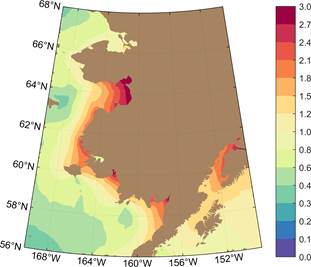
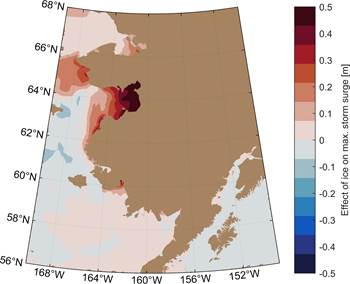
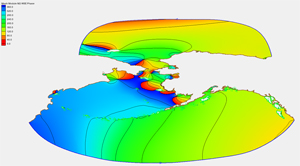
Simulation results of the largest storm surge event of the 2019 Alaskan Winter (maximum water levels for 7 day period from February 8 to 14, 2019 due to tides and surge, left), peaking on February 12-13th, that was enhanced due to the fractured ice conditions (maximum effect of fractured ice during the same 7 day period, right). |
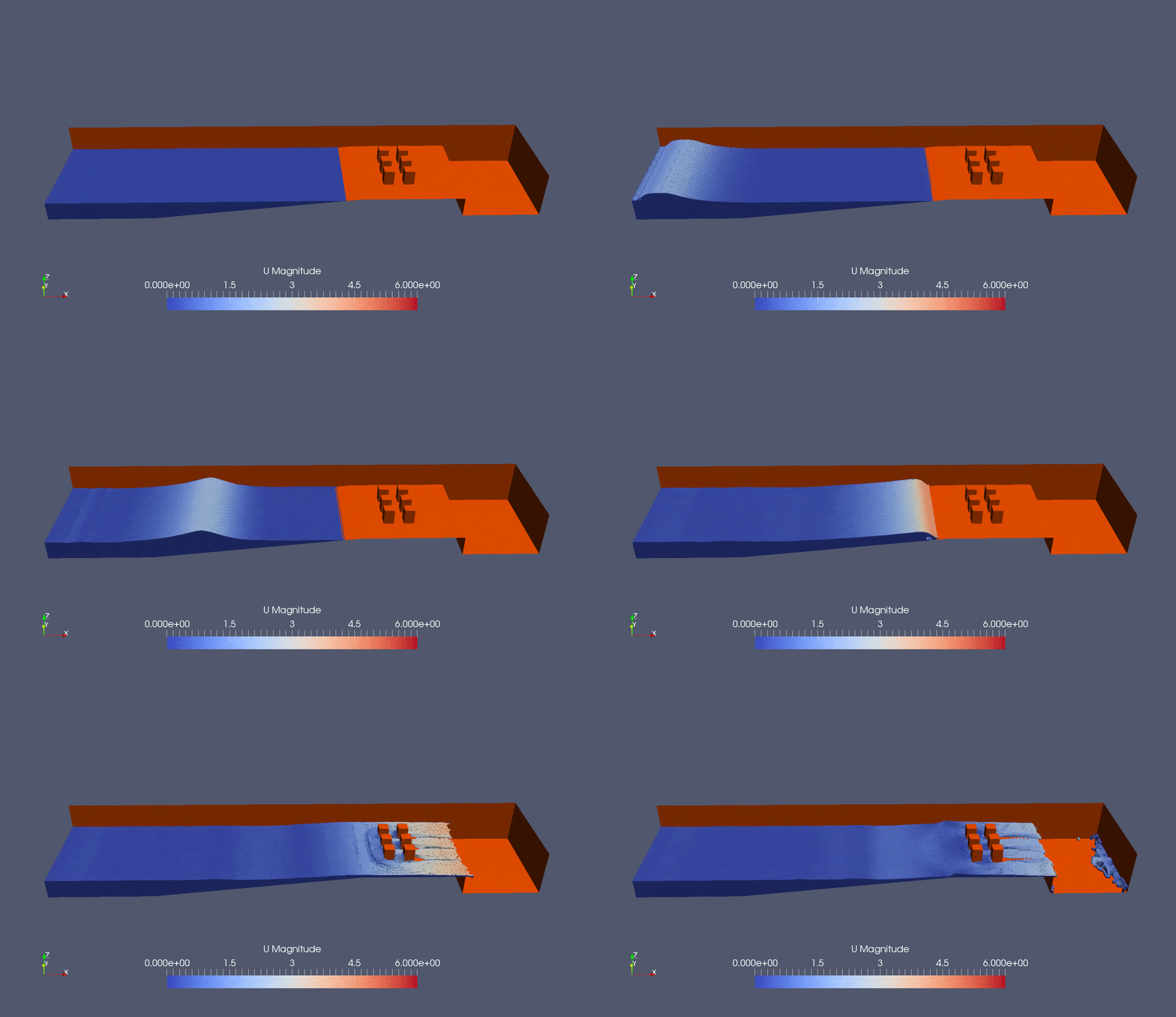
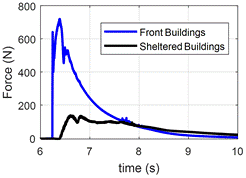
Coastal Inundation in Developed Regions Project Sponsor: National Institute of Standards (NIST) Project Team: Notre Dame: Andrew Kennedy (PI), Joannes Westerink (co-PI), Joaquin Moris (Ph.D. student), Mayilvahanan AlaganChella (Post-doctoral fellow) Project Goals: Develop and test methodologies to improve predictions of inundation hydrodynamics and loading in developed (urban) regions for both storm wave and tsunami inundation, as aligned with the National Windstorm Impact Reduction Program and the Structural Performance under Multi-Hazard Program. In particular, we will investigate how to improve accuracy and reduce uncertainty in the bare-earth computations which will continue to be used for the immediate future. The Applied Technology Council will convene a Project Oversight Committee to ensure that the research is in a form suitable for adoption by professionals, and will lead in the translation of this research to the profession. Thus, project results will be released in forms suitable for inclusion into professional standards.
|
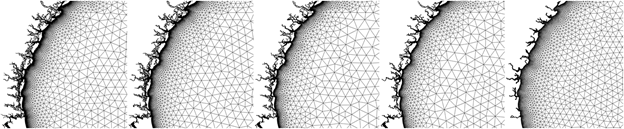
Development of a South Atlantic Mainland ADCIRC Mesh Project Sponsor: U.S. Army Corps of Engineers, Coastal Hydraulic Laboratory Project Team: Notre Dame: Joannes Westerink (PI), William Pringle (Research faculty), Maria Teresa Contreras-Vargas (Ph.D. student) Project Goal: Develop two high-fidelity, basin-to-channel unstructured meshes for the prediction of accurate water levels and currents along the United States South Atlantic. One model will be developed to compute with a higher timestep (2-s), while the other grid will compute at a smaller timestep (1-s) but contain more shoreline geometry. Upon completion, the 1-sec timestep mesh will be exchanged with another model development team at Louisiana State University (LSU) that will be working on the other sections of the Gulf of Mexico. The final high resolution mesh of the South Atlantic coastline will be merged together with the Gulf of Mexico model by the LSU team. Together these meshes will form a comprehensive model that spans the entire South Atlantic and Gulf of Mexico coastlines with high resolution triangular mesh elements. These models will be used to simulate water levels for the assessment of coastal risk in the North Atlantic Comprehensive Coastal Study Part II. |
The FMGlobal Integrated Western North Atlantic Coastal Hazard Model Project Sponsor: FM Global Project Team: Notre Dame: Joannes Westerink (PI), William Pringle (Research faculty), Keith Roberts (Ph.D. student), Maria Teresa Contreras-Vargas (Ph.D. student) Project Goal: Develop an integrated Western North Atlantic Ocean coastal hydrodynamic hazard model. Specifically an integrated model will be developed for all North Atlantic coasts including those in the Gulf of Mexico and Caribbean Sea focusing on water level and wave environments. The driving processes are the combination of tides, winds, atmospheric pressures and wind waves to determine coastal and inland flooding hazards, the currents associated with these processes to understand erosion and structural forces, and wind wave action to understand forces and allow for wave run up estimates. |
Improving Operational Forecasting Through Enhanced Ensemble Storm Selection Project Sponsor: National Oceanic and Atmospheric Administration (NOAA) Project Team: Notre Dame: Alex Taflanidis (PI), Joannes Westerink (co-PI) |
| Select Completed Projects |
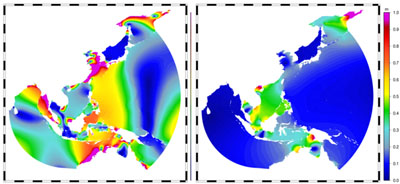
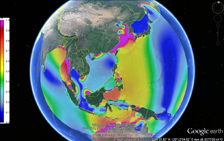
Tides and Storm Surge in the Indian Ocean and South China Sea |
NSF S12-SSI: Collaborative Research: STORM: A Scalable Toolkit for an Open Community Supporting Near Realtime High Resolution Coastal Modeling Collaborators: Hartmut Kaiser, Robert Twilley, LSU; Richard Luettich, UNC: Clint Dawson, UT Austin For more info see:
|
NSF Collaborative Research: Data-Driven Inverse Sensitivity Analysis for Predictive Coastal Ocean Modeling Project Sponsors: National Science Foundation Project Documentation: |
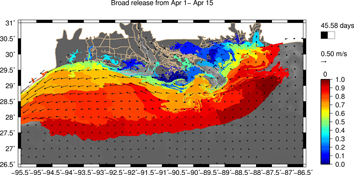
NOAA NRDA (Natural Resource Damage Assessment) ADCIRC Circulation Modeling: Deepwater Horizon Oil Spill Project Sponsors: NOAA Fisheries |
A High Resolution Integrally Coupled-Ice, Tide, Wind-Wave and Storm Surge Model for Western Alaska Project Sponsors: Western Alaska Landscape Conservation Cooperative, NCEP, NDS |
A Puerto Rico/U.S. Virgin islands, Surge and Wave Inundation Model Testbed Project Sponsors: IOOS, NOAA |
Model Development for Western North Pacific Project Sponsors: FM Global |
NSF CMG Collaborative Research: Simulation of Wave-Current Interaction Using Novel, Coupled and Non-Phase and Phase-Resolving Wave and Current Models Project Sponsor: National Science Foundation Project Documentation: |
SURA-IOOS Coastal and Ocean Modeling Testbed (SURA-IOOS COMT) Project Sponsors: IOOS, NOAA, Sura Project Documentation: |
Storm Surge Model Development and Applications for Southern Louisiana and Mississippi Project Sponsors: USACE-LACPR; USACE-MVN; USACE-HPO; FEMA Region VI Dietrich, J.C., J.J. Westerink, A.B. Kennedy, J.M. Smith, R. Jensen, M. Zijlema, L.H. Holthuijsen, C. Dawson, R.A. Luettich, Jr., M.D. Powell, V.J. Cardone, A.T. Cox, G.W. Stone, H. Pourtaheri, M.E. Hope, S. Tanaka, L.G. Westerink, H.J. Westerink, Z. Cobell, "Hurricane Gustav (2008) Waves and Storm Surge: Hindcast, Synoptic Analysis and Validation in Southern Louisiana," Monthly Weather Review, 139, 2488-2522, DOI 10.1175/2011MWR3611.1, 2011. Hope, M.E., J.J. Westerink, A.B. Kennedy, P.C. Kerr, J.C. Dietrich, C. Dawson, C.J. Bender, J.M. Smith, R.E. Jensen, M. Zijlema, L.H. Holthuijsen, R.A. Luettich Jr., M.D. Powell, V.J. Cardone, A.T. Cox, H. Poutaheri, H.J. Roberts, J.H. Atkinson, S. Tanaka, H.J. Westerink, and L.G. Westerink, "Hindcast and validation of Hurricane Ike (2008) waves, forerunner, and storm surge," Journal of Geophysical Research: Oceans, 118, 4424-4460, doi:10.1002/jgrc.20314, 2013. Kennedy, A.B., U. Gravois, B.C. Zachry, J.J. Westerink, M.E. Hope, J.C. Dietrich, M.D. Powell, A.T. Cox, R.A. Luettich, R.G. Dean, "Origin of the Hurricane Ike Forerunner Surge," Geophysical Research Letters, 38, L08608, DOI 10.1029/2011GL047090, 2011j, 2011. |
Storm Surge Model Development and Applications for Texas Project Sponsors: USACE-MVN; FEMA Region VI Kennedy, A.B., U. Gravois, B.C. Zachry, J.J. Westerink, M.E. Hope, J.C. Dietrich, M.D. Powell, A.T. Cox, R.A. Luettich, R.G. Dean, "Origin of the Hurricane Ike Forerunner Surge," Geophysical Research Letters, 38, L08608, DOI 10.1029/2011GL047090, 2011j, 2011. **Texas FEMA Report** |
Collaborative Research: NSF PetaApps Storm Surge Modeling on Petascale Computers Project Sponsor: National Science Foundation Award No. OCI-0746232 Dietrich, J.C., S. Tanaka, J.J. Westerink, C.N. Dawson, R.A. Luettich, Jr., M. Zijlema, L.H. Holthuijsen, J.M. Smith, L.G. Westerink, H.J. Westerink, "Performance of the Unstructured-Mesh, SWAN+ADCIRC Model in Computing Hurricane Waves and Surge," Journal of Scientific Computing, 52, 468-497, 2012. |
Air-Sea Interaction and Flow Resistance, Wave-Current and Vegetation Effects for Hurricane Storm Surge Computation Project Sponsor: USACE-Morphos Kerr, P.C., J.J. Westerink, J.C. Dietrich, R.C. Martyr, S. Tanaka, D.T. Resio, J.M. Smith, H.J. Westerink, L.G. Westerink, T. Wamsley, M. van Ledden, W. deJong, "Surge Generation Mechanisms in the Lower Mississippi River and Discharge Dependency,"Journal of Waterway, Port, Coastal, and Ocean Engineering, 139, 326-335, 2013. |
Riverine Flows, Tides and Surge in the Lower Mississippi River and Delta and Atchafalaya River and Delta Project Sponsor: USACE-MVN |
Hurricane Inundation Risk in the North Pacific Ocean Project Sponsor: U.S. Army Engineer Research and Development Center, Coastal Hydraulics Laboratory Taflanidis, A.A., A.B. Kennedy, J.J. Westerink, J. Smith, K.F.Cheung, M. Hope, S. Tanaka, "Rapid Assessment of Wave and Surge Risk during Landfalling Hurricanes: Probabilistic Approach", Journal of Waterway, Port, Coastal, and Ocean Engineering, 139, 171-182, 2013. |
Supplemental Funding Request for the Application of the ADCIRC Coastal Circulation Model for Predicting Near Shore and Inner Shore Transport of Oil from the Horizon Oil Spill Project Sponsor: National Science Foundation RAPID; Department of Homeland Security |
CMG Collaborative Research: Adaptive Numerical Methods for Shallow Water Circulation with Applications to Hurricane Storm Surge Modeling Project Sponsor: National Science Foundation Award No. DMS-0620696 |
Wave and Circulation Prediction on Unstructured Grids Project Sponsor: Office of Naval Research Award No. N00014-06-1-0285 |
 |
Copyright@2019 University of Notre Dame Notre Dame, IN 46556 Site updated February 2022 |