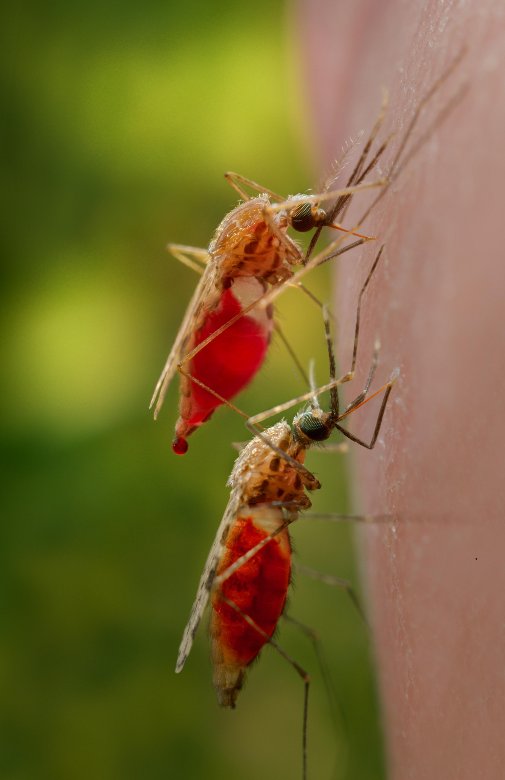

RESEARCH
An. gambiae taking a blood meal. J. Gathany, CDC
In my laboratory, we apply molecular approaches to problems ranging from generic relationships within Family Culicidae (mosquitoes) to relationships at and below the species level (see Krzywinski & Besansky, 2003). Past and present research at different taxonomic levels addresses questions such as mosquito phylogeny, anopheline biogeography, the nature of species boundaries, and the forces that have structured genetic and genomic variation within and between species. Most current projects focus on the African species Anopheles gambiae, the most important vector of human malaria.
The publication of the complete An. gambiae genome in 2002 had a profound impact not only on the pace of scientific discovery, but also on its scope. It has made possible the goal of identifying the genes and/or regulatory networks underlying ecological differentiation, speciation, and vectorial capacity. Toward that end, we are using gene expression and genomic microarray analysis as a first step in probing genetic mechanisms of adaptation and reproductive isolation. We are carrying out these studies in the context of complementary ecological field studies with our collaborators working in Africa. Major topics of investigation in my laboratory (Chromosomal inversions, Speciation in Anopheles gambiae, Systematics of Culicidae, and Comparative Genomics) are outlined below. Additional non-technical background can be found in "What Makes A. gambiae Tick", an article from the Winter 2005 issue of Pathways, our Department newsletter.
Chromosomal Inversions
 
Left: Inversion heterokaryotype (2La/+a) in An. gambiae (courtesy of M. Unger); Right: Chromosomal inversions on 3R in An. funestus (courtesy of O. Grushko).
Chromosomal rearrangements are major architects of evolution in various groups of organisms. In anopheline mosquitoes, synteny has been highly conserved but gene order is extensively shuffled primarily through paracentric chromosomal inversions. The processes responsible for the origin of chromosomal inversions, still poorly understood, can be illuminated by analysis of inversion breakpoint sequences. My laboratory is actively engaged in molecular cloning and sequence characterization of polymorphic inversions on chromosome 2 in An. gambiae. This information not only yields insights about how inversions arise, but also provides the basis for DNA-based strategies to determine the karyotype of both sexes and all developmental stages, overcoming the major limitations to traditional karyotype analysis. We have developed and extensively validated PCR assays for molecular karyotyping of the 2La and 2Rj inversions.
These tools provide an entry point to the ecological genomics of chromosomal inversions in An. gambiae. Compelling data testify to the nonrandom distribution of these inversions with respect to environmental variables such as degree of aridity.

The relationship between chromosome-2 inversion frequencies and aridity from the humid Niger River delta of S. Nigeria to the arid sahel of Niger. Modified from Coluzzi et al., 1979. For larger image, click here.
These data suggest that alternative arrangements are differentially adapted to arid environments. Although the relationship between inversions and aridity has been known for nearly 30 years, its genetic basis is unknown and few attempts have been made to find correlations with other potentially relevant ecological and malariological parameters. The complete sequence of the An. gambiae genome and rapid molecular karyotype analysis allow us to address this longstanding question, by comparing patterns of gene expression and sequence differences between alternative arrangements and by relating these features to the distribution of inversions in the environment.
This work is being carried out in collaboration with scientists from the University of Rome "La Sapienza", Rome, Italy; Institut de Recherche pour le Développement and Organisation de Coordination pour la Lutte contre les Endémies en Afrique Centrale, Yaounde, Cameroon; Malaria Research and Training Center, Bamako, Mali; and Indiana University, Bloomington, IN USA. It has been supported by NIAID and by the UNICEF/UNDP/World Bank/WHO Special Programme for Research and Training in Tropical Diseases (TDR).
Related publications:
SHARAKHOV, I.V., SERAZIN, A.C., GRUSHKO, O.G., DANA, A., LOBO, N., HILLENMEYER, M.E., ROMERO-SEVERSON, J., COSTANTINI, C., SAGNON, N.’F., COLLINS, F.H., and BESANSKY, N.J. (2002) Inversions and gene order shuffling in Anopheles gambiae and A. funestus. Science 298: 182-185.
SHARAKHOV, I.V., WHITE, B., SHARAKHOVA, M., KAYONDO, J.K., LOBO, N.F., SANTOLOMAZZA, F., DELLA TORRE, A., SIMARD, F., COLLINS, F.H. and BESANSKY , N.J. (2006) Breakpoint structure reveals the unique origin of an interspecific chromosomal inversion (2La) in the Anopheles gambiae complex. Proc Natl Acad Sci 103: 6258-6262.
WHITE, B.J., SANTOLAMAZZA, F., KAMAU, L., POMBI, M., GRUSHKO, O., MOULINE, K., BRENGUES, C., GUELBEOGO, W., COULIBALY, M., KAYONDO, J.K., SHARAKHOV, I. , SIMARD, F., PETRARCA, V., DELLA TORRE, A. and BESANSKY , N.J. (2007) Molecular karyotyping of the 2La inversion in Anopheles gambiae. Am J Trop Med Hyg 76: 334-339.
STUMP, A.D., POMBI, M., GOEDDEL, L., RIBEIRO, J.M.C., WILDER, J.A., DELLA TORRE, A., and BESANSKY, N.J. (2007). Genetic exchange in 2La inversion heterokaryotypes of Anopheles gambiae. Insect Mol Biol 16:703-709.
COULIBALY, M.B., LOBO, N.F., FITZPATRICK, M., KERN, M., GRUSHKO, O., THANER, D.V., TRAORÉ, S.F., COLLINS, F.H., and BESANSKY, N.J. (2007) Segmental duplication implicated in the genesis of inversion 2Rj of Anopheles gambiae. PLoS ONE, 2(9): e849.
COULIBALY, M.B., POMBI, M., CAPUTO, B., NWAKANMA, D., JAWARA, M., KONATE, L., DIA, I., FOFANA, A., KERN, M., SIMARD, F., CONWAY, D., PETRARCA, V., DELLA TORRE, A., TRAORÉ, S., and BESANSKY, N.J. (2007) PCR-based karyotyping of Anopheles gambiae inversion 2Rj identifies the BAMAKO chromosomal form. Malaria J, 6:133.
WHITE, B.J., HAHN, M.W., POMBI, M., CASSONE, B.J., LOBO, N.F., SIMARD, F. and BESANSKY, N.J. (2007) Localization of candidate regions maintaining a common polymorphic inversion (2La) in Anopheles gambiae. PLoS Genetics 3(12): e217.
POMBI, M., CAPUTO, B., SIMARD, F., DI DECO, M. A., COLUZZI, M., DELLA TORRE, A., COSTANTINI, C., BESANSKY, N. J., PETRARCA, V. (2008) Chromosomal plasticity and evolutionary potential in the malaria vector Anopheles gambiae sensu stricto: insights from three decades of rare paracentric inversions. BMC Evolutionary Biology, in review.
Speciation in Anopheles gambiae

Left: Ricefield breeding site typical of An. gambiae M form; Right: Rain-filled rut in the road, typical breeding site of An. gambiae S form. Photos courtesy of C. Costantini
Anopheles gambiae s.s. is subject to an ongoing speciation process which has resulted in increased malaria transmission spatially and temporally. Ecological adaptation associated with the speciation process has allowed exploitation of environments that formerly excluded An. gambiae: arid seasons and zones subject to irrigation for agriculture. It has been assumed that the arid-adapted incipient species (An. gambiae form M) shifted larval habitats from rain-dependent pools and puddles characteristic of An. gambiae form S to anthropogenic breeding sites associated with irrigation. However, the relevant ecological features used by the M and S forms as cues to partition their environment at different spatial scales and developmental stages have not been established. We aim to study ecological adaptation at phenotypic and genotypic levels because we believe that this phenomenon is central to what makes An. gambiae the most efficient vector of malaria, and that an understanding of how it works will expose novel targets for control. We are complementing ecological field studies of An. gambiae M and S at different spatial scales with a population genomic examination of adaptation based on exceptionally diverged chromosomal regions (“speciation islands”) that we hypothesize control the different ecophenotypes. Toward the ultimate goal of identifying the genes underlying these ecophenotypes, we are applying a “top-down” approach in which key ecological differences between M and S will be carefully defined and a “bottom-up” approach involving multilocus genome and transcriptome scans for candidate genes likely to be associated with ecological and reproductive divergence of M and S. Within this framework, we are pursuing the following specific aims: (1) Validate the hypothesis that M and S partition their habitat, and characterise the realised niche of each form at different spatial scales. (2) Define the spatial and temporal patterns of chromosomal polymorphism within M and S in relation to environmental heterogeneities. (3) Identify genes potentially associated with differential adaptations of M and S.
This work is being carried out in collaboration with scientists from the Centre National de Recherche et de Formation sur le Paludisme (CNRFP), Ouagadougou, Burkina Faso; the Institut de Recherche en Sciences de la Santé (IRSS), Bobo Dioulasso, Burkina Faso; the Institut de Recherche pour le Developpement (IRD), OCEAC, Yaounde, Cameroon; the University of Rome “La Sapienza”, Rome, Italy; and Indiana University, Bloomington, IN USA. It is supported by NIAID.

At a collaborators meeting in Ouagadougou, Burkina Faso, December 2005. Back row from left: N'F. Sagnon, W. M. Guelbeogo, I. H.N. Bassole, and E. Dibouloin; front row from left: N.J. Besansky, A. della Torre, R. Dabire, C. Costantini, F. Simard, D. Fontenille.
Related publications (including studies of An. funestus):
MUKABAYIRE, O., CARIDI, J., WANG, X., TOURÉ, Y., COLUZZI, M. and BESANSKY , N.J. (2001) Patterns of DNA sequence variation in chromosomally recognized taxa of Anopheles gambiae: Evidence from rDNA and single copy loci. Insect Mol Biol 10: 33-46.
DELLA TORRE, A., COSTANTINI, C., BESANSKY , N.J. , CACCONE, A., PETRARCA, V., POWELL, J.R., and COLUZZI , M. (2002) Molecular and ecological aspects of incipient speciation within Anopheles gambiae: the glass is half full. Science 298: 115-117.
KRZYWINSKI, J. and BESANSKY , N.J. (2003) Molecular systematics of Anopheles: from subgenera to subpopulations. Annu. Rev. Entomol. 48: 111-139.
BESANSKY , N.J. , KRZYWINSKI, J., LEHMANN, T., SIMARD, F., KERN, M., MUKABAYIRE, O., FONTENILLE, D., TOURÉ, Y. and SAGNON, N’F. (2003) Semipermeable species boundaries between Anopheles gambiae and An. arabiensis: evidence from multilocus DNA sequence variation. Proc Natl Acad Sci USA 100: 10818-10823.
GUELBEOGO, W. M., GRUSHKO, O., BOCCOLINI, D., OUEDREOGO, P.A., BESANSKY, N. J., SAGNON, N.’F., and COSTANTINI, C. (2005) Chromosomal evidence of incipient speciation in the Afrotropical malaria mosquito Anopheles funestus in Burkina Faso. Med Vet Entomol 19: 458- 469.
STUMP, A. D., SCHOENER, J. A., COSTANTINI, C., SAGNON, N.’F., and BESANSKY , N.J. (2005) Sex-linked differentiation between incipient species of Anopheles gambiae. Genetics 169: 1509-1519.
BARNES, M. J., LOBO, N. F., COULIBALY, M. B., SAGNON, N. F., COSTANTINI, C. and BESANSKY, N. J. (2005) SINE insertion polymorphism on the X chromosome differentiates Anopheles gambiae molecular forms. Insect Mol Biol 14:353-363.
MICHEL, A. P., GUELBEOGO, W. M., GRUSHKO, O., SCHEMERHORN, B. J., KERN, M., WILLARD, M. B., SAGNON, N’F., COSTANTINI, C. and BESANSKY, N. J. (2005) Molecular differentiation between chromosomally defined incipient species of Anopheles funestus. Insect Mol Biol 14: 375-387.
Stump, A.D., Fitzpatrick, M., Lobo, N.F., TRAORÉ, S., Sagnon, N.’F., Costantini, C., COLLINS, F.H. and Besansky , N.J. (2005) Centromere-proximal differentiation and speciation in Anopheles gambiae. Proc Natl Acad Sci USA 102: 15930-15935.
MICHEL, A.P., GRUSHKO, O., GUELBEOGO, W.M., LOBO, N.F., SAGNON, N’F., COSTANTINI, C., and BESANSKY, N.J. (2006) Divergence with gene flow in Anopheles funestus from the Sudan Savanna of Burkina Faso, West Africa. Genetics 173: 1389-1395.
MARCO P., STUMP, A.D., DELLA TORRE, A., and BESANSKY , N.J. (2006) Variation in recombination rate across the X chromosome of Anopheles gambiae. Am J Trop Med Hyg 75: 901-903.
CASSONE, B. J., MOULINE, K., HAHN, M. W., WHITE, B. J, POMBI, M.,
SIMARD, F., COSTANTINI, C., and BESANSKY, N. J. (2008) Differential gene expression in incipient species of Anopheles gambiae. Mol Ecol 17: 2491-2504.
MANOUKIS, N., POWELL, J. R., TOURÉ, M. B., SACKO, A., EDILLO, F. E., COULIBALY, M. B., TRAORÉ, S. F., TAYLOR, C. E. and BESANSKY, N. J. (2008) A test of the chromosomal theory of ecotypic speciation in Anopheles gambiae. Proc Natl Acad Sci 105: 2940-2945.
Systematics of Culicidae
“ All species are members of groups of more or less closely related species, and each species can only be understood in the his torical context of belonging to groups united in the past into single lineages .” J. R. Powell, 1997
The ~3200 recognized species of mosquitoes (Family Culicidae) are monophyletic. They occupy all continents except Antarctica and are most diverse in the tropics. Though most species do not transmit human diseases-- indeed most do not even bite humans-- this group contains vectors of West Nile Virus, filariasis, dengue, yellow fever and malaria. Modern systematic effort has been limited mainly to subgeneric or species groups of certain regions, particularly those containing vector species. Generic relationships within Culicidae have not been established using modern approaches; they are based on the classical tradition of intuitive interpretations of morphological data and do not represent an entirely natural classification. Inference of evolutionary relationships at the generic level (based on molecules and morphology) will provide the framework for a natural classification of Culicidae predictive of biological traits, a goal that is justified by the medical and economic impact of this group, its ecological diversity, and the opportunity to train young scientists in mosquito systematics and taxonomy before the few remaining experts retire. Preliminary studies within Culicidae clearly have revealed the challenge of elucidating a generic level phylogeny: divergence events were ancient (probably Mesozoic, 65-250 mya) yet also rapid (Krzywinski et al. 2001b; Krzywinski et al. 2006). For molecular markers, the most promising approach to gain maximal phylogenetic utility in this situation is to employ genes with a mosaic structure of domains evolving at different rates: conserved domains for primer design and more rapidly evolving domains (Moulton 2003; Moulton & Wiegmann 2004). We are in the process of evaluating candidate genes for their utility.
This work is being carried out in collaboration with scientists from the Natural History Museum, London and the Smithsonian Institution/WRAIR. We are currently seeking grant support. Donations gratefully accepted.
Related publications:
BESANSKY, N.J. , and FAHEY, G.T. (1997) Utility of the white gene in estimating phylogenetic relationships among mosquitoes. Mol Biol Evol 14:442-454.
KRZYWINSKI, J., WILKERSON, R. and BESANSKY , N.J. (2001a) Evolution of mitochondrial and ribosomal gene sequences in Anophelinae (Diptera: Culicidae): implications for phylogeny reconstruction. Mol Phylogenetics Evol 18: 479-487.
KRZYWINSKI, J., WILKERSON, R. and BESANSKY , N.J. (2001b) Toward understanding Anophelinae (Diptera: Culicidae) phylogeny: insights from nuclear single copy genes and the weight of evidence. Systematic Biol 50: 540-556.
KRZYWINSKI, J. and BESANSKY , N.J. (2003) Molecular systematics of Anopheles: from subgenera to subpopulations. Annu. Rev. Entomol. 48: 111-139.
KRZYWINSKI, J, GRUSHKO, O.G., and BESANSKY , N.J. (2006)Analysis of the complete mitochondrial DNA from Anopheles funestus: an improved dipteran mitochondrial genome annotation and a temporal dimension of mosquito evolution. Mol Phylogenet Evol 39:417-423.
Comparative Genomics: Multiple Anopheles Genomes
When the first draft of the An. genome sequence was announced in October 2002 (Holt et al., 2002) , it was only the second insect to have its genome completely sequenced after Drosophila melanogaster. This species was chosen because of its undisputed biomedical importance as a vector of malaria. As efforts to sequence the genomes of other arthropod vectors of human diseases such as dengue, filariasis, West Nile and Lyme Disease are at various stages of planning or progress, it is pertinent to ask why funding agencies should invest more resources to sequence the genomes of additional anopheline malaria vectors. The answer lies in the power of comparative genomics, given that comparisons are made at the appropriate evolutionary depths. The argument developed in the August 2008 white paper proposal to the National Human Genome Research Institute (NHGRI) is twofold: comparative genomics of anopheline species is essential both for advancing the currently incomplete structural and functional annotation of the An. gambiae genome, and for advancing our knowledge about the modifications of genome sequence and organization that allowed a handful of anopheline species to evolve rapidly into the most dangerous vectors through specialization on humans.
Major considerations for choice of target species were: (1) availability of well-established colonies, (2) vector status, and (3) degree of evolutionary divergence from An. gambiae, the anchor of the project. Within this framework, we proposed to sequence three species very closely related to An. gambiae (in the same sibling species complex: An. arabiensis, An. merus and An. quadriannulatus-- a nonvector), eight additional species within the same subgenus Cellia (An. epiroticus, An. stephensi, An. maculatus B, An. funestus, An. minimus A, An. culicifacies A, An. farauti 1, and An. dirus A), one species from the sister subgenus Anopheles (An. atroparvus), and one from a more distant subgenus Nyssorhynchus (An. albimanus). The absolute requirement of laboratory colonization severely limited the choices of vector species.
On June 8, 2005 NHGRI announced that part of the original (2004) white paper proposal had been approved: the sequencing of An. gambiae M and S form genomes. You can read the full press release at: http://www.genome.gov/15014493. Besansky is coordinating the NHGRI-supported sequencing and analysis of the M and S genomes by the J. Craig Venter Institute (JCVI; S form) and the Washington University School of Medicine Genome Sequencing Center (WUGSC; M form). The DNA source for the S form was the Pimperena colony (available through MR4), established from collections in Pimperena, Mali in November 2005 by combining ~5 isofemale families (~20 genome-equivalents) molecularly identified as A. gambiae S. The DNA source for the M form was the Mali-NIH colony (MR4), derived from collections near Niono, Mali in June 2005 by combining ~80 isofemale families molecularly identified as A. gambiae M. The combined plasmid, fosmid and BAC end sequence reads for both genomes (~2.7 million traces from each genome, available in the NCBI Trace Archives) were assembled de novo by JCVI using the Celera Assembler and by WUGSC using the Pcap assembler. Because the algorithms developed at JCVI to accommodate sequence heterozygosity gave improved assemblies, both sequencing centers agreed on the JCVI assemblies submitted to GenBank as the canonical assemblies for M and S annotation and analysis (ABKP00000000 and ABKQ00000000, respectively). With reference to the A. gambiae PEST genome, there is a high level of concordance for both S and M genomes, with ~99% of annotated PEST genes being identified in each of the latter two assemblies. Moreover, 1-to-1 mappings of the assembly-to-assembly comparisons to PEST (i.e., each M or S scaffold mapped to only one PEST chromosome) suggest highly satisfactory assemblies despite the presence of sequence heterozygosity: the summed lengths of M (or S) scaffolds that map to PEST chromosomes 2L, 2R, 3L and 3R are 93-100% of the PEST chromosome lengths; for X, owing to the lower sequence coverage, the summed lengths are 89% for both M and S. Comparative genomic analysis is in process, assisted by computer scientists led by Scott Emrich in the Dept. of Engineering at Notre Dame, and by population/evolutionary/statistical geneticists Alisha Holloway (Univ. CA, Davis), Mara Lawniczak (Imperial College, UK), and Matt Hahn (Indiana Univ. Bloomington). Upon completion, the genomic analyses of M and S will be published in an appropriate high-impact journal (anticipated in 2008).
A wealth of important and exciting data related to speciation and the origin of chromosomal inversions will emerge from the the An. gambiae M and S genomes. However, the scientific and public health importance of additional anopheline genomes at appropriate evolutionary distances from An. gambiae cannot be overstated. One important application of the An. gambiae genome sequence is to locate and characterize those traits that confer high vectorial capacity, with the ultimate goal of altering or blocking their function. It seems likely that many of these traits are rapidly evolving and recently derived-- multiple independent times in different anopheline lineages. Comparative genomics approaches are vital to their discovery, and such approaches will require levels of divergence far more shallow than Anopheles-Culex/Aedes (~180MYA; Krzywinski et al., 2001). |