|
AffiliationsAdjunct Professor, Mathematics Department, University of Notre Dame, Notre Dame, IN Technical Fellow, General Motors Research and Development Center, Warren, MI |
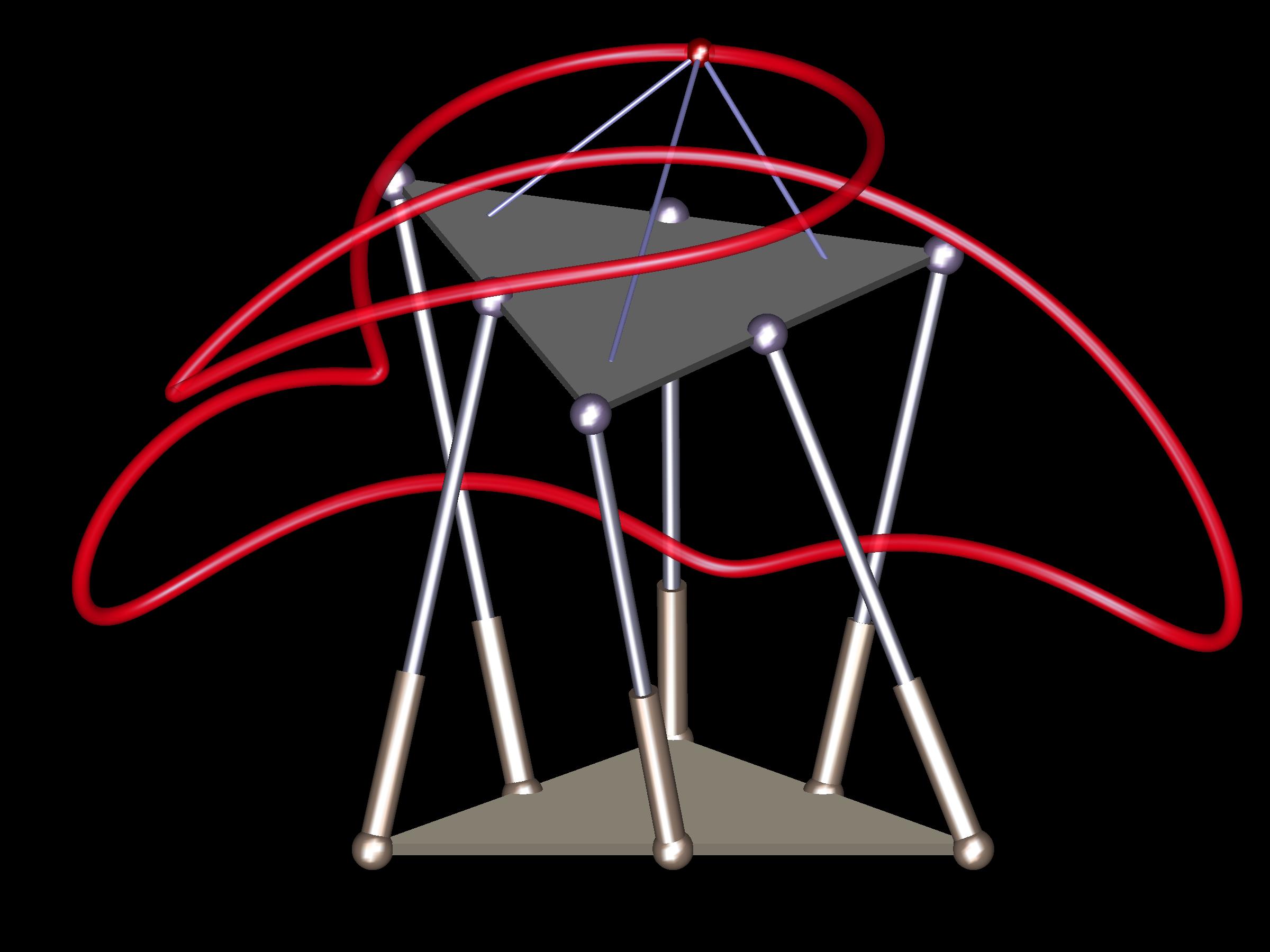
I primarily study the kinematics of robots and mechanisms. This field is concerned with collections of rigid bodies with geometric constraints between them. Examples of such constraints are rotational hinges, prismatic (linearly sliding) joints, and spherical (ball-and-socket) joints. Mathematical models based on ideal joints and rigid bodies closely approximate the motion of many practical devices.
The most common geometric constraints involve entities that are algebraic (points, lines, planes, cylinders, and spheres), and since squared distances are algebraic also, the mathematical models are algebraic. Thus, the questions to be answered fall within the domain of algebraic geometry. In the late 19th century and early 20th century, these questions were actively pursued in mathematical circles, and such well-knowns as Cayley, Chebychev, Kempe, Schönflies, Study, and Sylvester made significant contributions. Subsequently, the thread of mathematical inquiry in kinematics was nearly lost due to the movement to mathematical abstraction, only to re-emerge in the late 20th century as the bloom of robotics inspired engineers to ask new and difficult questions that have once again drawn the attention of applied mathematicians.
To answer questions from kinematics, as well as algebraic questions from other disciplines such as chemistry and computer graphics, one needs to describe and manipulate the solution sets of systems of polynomial equations. One of several computational techniques for addressing these systems is polynomial continuation. In 1995, Andrew Sommese (Notre Dame) and I coined the term numerical algebraic geometry to describe a new class of algorithms to deal with positive-dimensional solution sets, built on top of existing techniques of polynomial continuation for finding isolated solutions. In past work with Jan Verschelde (UIC), our developments include new algorithms and refinements to compute irreducible decompositions, membership tests, and the intersection of algebraic varieties. Currently, I'm working with Andrew Sommese, Daniel Bates, and Jon Hauenstein on extensions to these methods and on the software package, Bertini (see below).
Work at General Motors
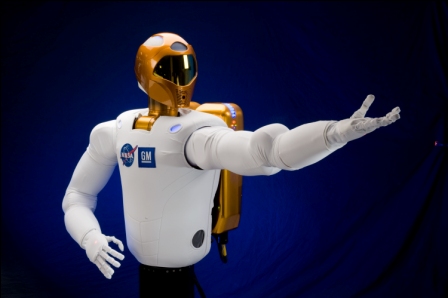
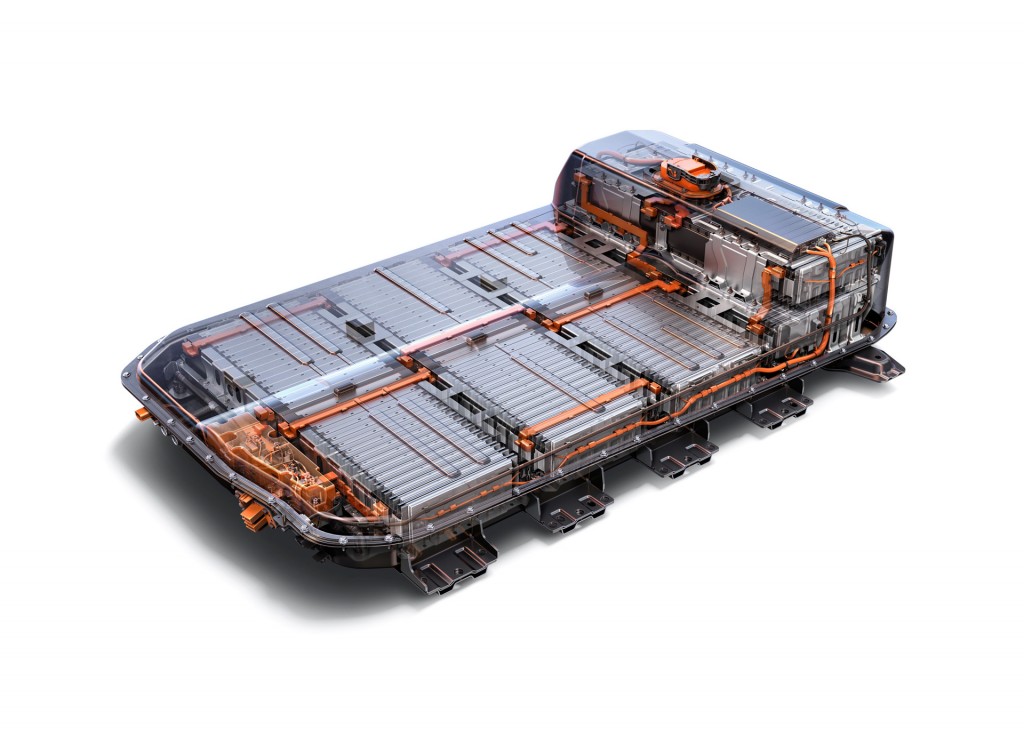
In addition to the work described in my research publications, I earn my keep, so to speak, by helping GM develop and deploy applications of robotics and related technologies in our manufacturing facilities. An important thrust has been the use of programmable tooling in the production of automotive bodies, allowing flexible production of multiple body styles on the same equipment and faster introduction of new models. A top concern is making this equipment accurate, so that our vehicles are of the highest quality, which effort is connected to my research in robot calibration.
For more about the connection between kinematics and polynomials, along with an introduction to polynomial continuation and numerical algebraic geometry, view the slide show from my keynote talk at the ASME Mechanisms and Robotics Conference, Salt Lake City, Sept.29, 2004. (It will open in a new window.)
- Recent Book
![]()
The Numerical Solution of Systems of Polynomials Arising in Engineering and Science
by Andrew J. Sommese and Charles W. Wampler, II
World Scientific, 2005-- is now available from World Scientific.
You can also order it from the major internet booksellers.
Here is a list of errata.
See below to download the homotopy continuation codes that accompany the book. This includes a general-purpose package called HomLab (a suite of Matlab m-files) along with codes to be used in working the exercises at the end of each chapter.- Publication list in PDF format.
- Preprints of many of my publications in polynomial continuation can be downloaded from the websites of my colleagues, Andrew Sommese and Jan Verschelde.
- Bertini 1.0 release on 4/21/08!
by Daniel Bates, Jon Hauenstein, Andrew Sommese, and Charles Wampler, is a C program for solving polynomial systems.
Key features:
- Finds isolated solutions by total degree or multihomogeneous degree homotopies.
- Implements the latest method, called "regeneration," which efficiently finds isolated solutions by introducing the equations one-by-one.
- Finds positive dimensional solution sets and breaks them into irreducible components.
- Has multiprecision and adaptive multiprecision arithmetic for maintaining accuracy in larger problems (implemented for isolated case only at present).
- Power series endgame for fast, accurate treatment of singular roots.
- Simple input file format.
- Provides for construction of parameter homotopies
- HomLab
by Charles Wampler, is a suite of MatLab routines for learning about polynomial continuation. Although created for use with the book by Sommese and Wampler, HomLab is a general-purpose solver, fast enough for moderately-sized systems. If you are concerned about speed, numerical accuracy, and user-friendliness, try Bertini. If you want to learn the techniques of polynomial continuation from the inside, HomLab is your entry point.
Key features:
- Isolated solutions by total degree, multihomogeneous degree, or linear products
- Parameter continuation for families of systems, such as the inverse kinematics of six-revolute serial-link arms, or the forward kinematics of Stewart-Gough parallel-link robots.
- Treats positive-dimensional solutions by computing witness sets.
- Provides two ways of specifying a system
- "tableau" style for easy representation of simple systems
- straight-line functions written as Matlab m-files, for greater efficiency
- Uses homogenization to accurately compute solutions "at infinity."
- Provides a fractional power-series endgame to accurately compute singular roots (up to multiplicity approximately 4).
- PHC
is a full-featured code written in Ada, by Jan Verschelde.
Key features:
- Treatment of isolated solutions includes polyhedral homotopy (also known as the BKK approach, mixed volume, or polytope method).
- Treatment of positive-dimensional solutions includes irreducible decomposition and diagonal homotopy.
- The PHC pages also include a large collection of interesting examples.
- HOM4PS-2.0 and HOM4PS-2.0para
by T.Y. Li, T.L. Lee, and C.H. Tsai. Fortran code for polyhedral homotopy (serial and parallel versions). Key features:
- Very fast polyhedral homotopy method. Uses the authors' latest advances in computing mixed cells, the core combinatorial step required to define a polyhedral homotopy.
- If you know of other publicly available packages, please contact me so I can link to them.
General Motors R&D Center, MC 480-106-359, 30500 Mound Road, Warren, MI 48090-9055, USA
charles.w.wampler(at)gm.com
Maintained by Charles Wampler/ charles.w.wampler(at)gm.com /revised April 21, 2008